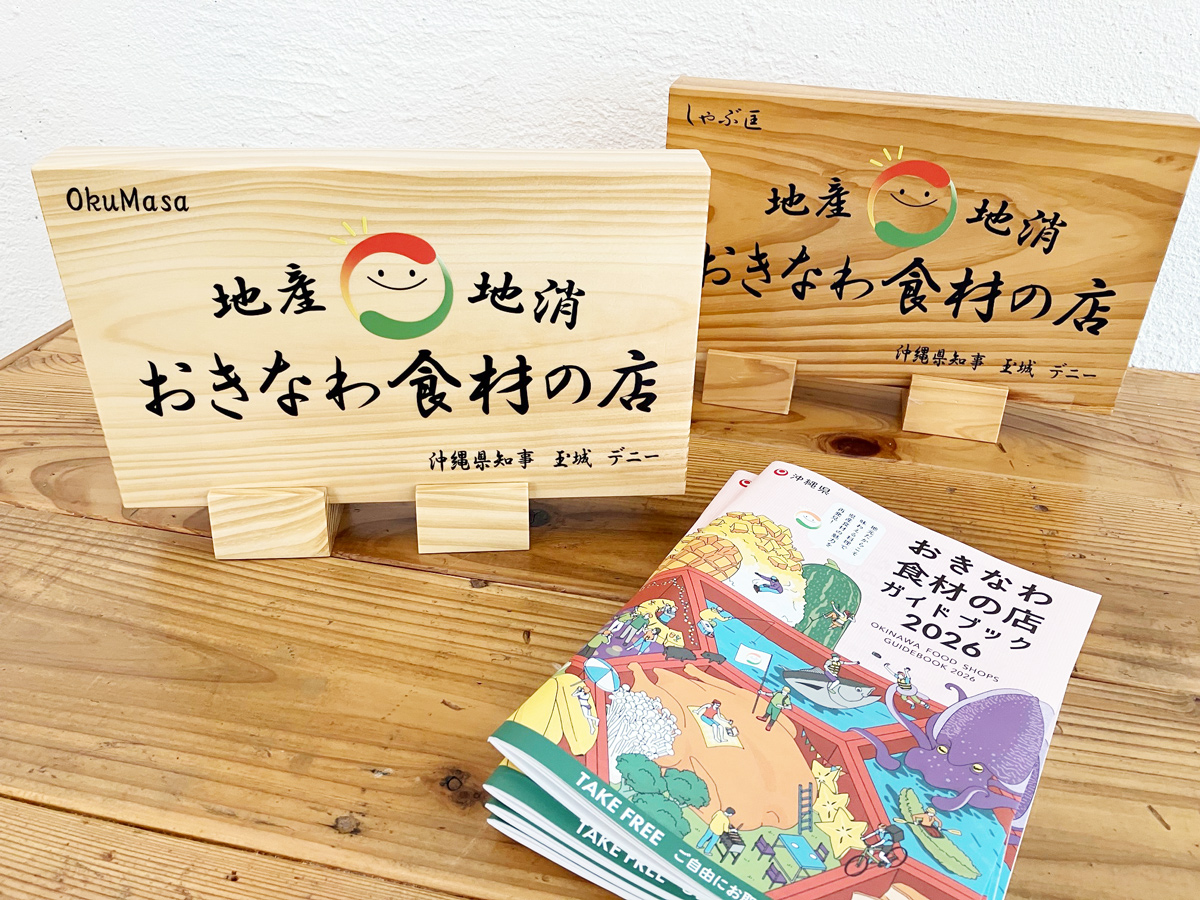
A familiar Ryukyu pinewood plaque with Governor Denny Tamaki’s name has arrived at OkuMasa.
We take pride in what may be Okinawa’s most diverse use of Yanbaru island vegetables, and we make full use of Yanbaru young chicken, Motobu beef, and seafood from our local fishing ports throughout our courses.
Okinawa is said to have 21,331 food and beverage businesses as of July 2025.
Among them, 479 restaurants are registered and introduced by the prefecture as “Okinawa Ingredients Certified Restaurants,” recognized for actively using Okinawa-produced ingredients.
In other words, restaurants that proudly champion local ingredients and continue to share their value are still only a small fraction of the whole.
And with this registration, there are now two certified restaurants associated with Chef Arasaki among those 479.
We don’t see this as the goal—if anything, we see it as the beginning.
To bring the value of Okinawa’s ingredients, producers, and communities further into the world through the work of cooking.
We want the appeal of Okinawan ingredients to be communicated accurately, chosen by more people, and sustained for years to come.
As one restaurant working on the ground, we will do what we can to encourage a growing number of peers to take on the “Okinawa Ingredients Certified Restaurant” initiative.
And we do not want that encouragement to end with words alone.
As restaurants led by Chef Arasaki, we hope to increase the number of establishments that take on this initiative.
For that, we are currently looking for teammates to build the restaurant together with us.
What we aim for is “the best possible flavor” and “a sense of ease for people,” without being confined by genre.
From shabu-shabu and Western cuisine to spice-driven dishes such as curry.
With Okinawan ingredients and the seasons of Yanbaru at the center, we want to create food of a standard we can be proud of globally, using new techniques and sensibilities that include both Okinawan traditions and methods from many countries. And we want to expand these values beyond a single restaurant—from one point into a wider field of restaurants.
That is our vision.
We are looking for people who can build this together as a team: respect for island ingredients and producers, uncompromising preparation, a willingness to keep learning, honesty in bringing the food directly to guests—and the kind of personal integrity that makes working together feel good.
Why We Are Doing This
“Create world-class excellence with Okinawan ingredients.”
Standing on the front line of that challenge, we have nurtured OkuMasa here in Kunigami Village, part of a World Natural Heritage region.
Okinawa has ingredients worthy of global pride. Yet there are still far too few genuinely quality-focused restaurants, and the mechanism for delivering that value is not functioning as it should. We have strongly felt that even local residents are not fully receiving the ingredients’ true value.
Put another way, there is still plenty of room to increase the number of truly good restaurants that can continue for the long term.
If that does not happen, Okinawa—Japan’s closest region to Southeast Asia—will not develop enough reasons for people to return again and again.
That is why we want to communicate the appeal of island ingredients directly from the kitchen.
We want the value of the ingredients, producers, and communities to be conveyed accurately, chosen by more people, and sustained for years to come.
As one restaurant working on the ground, we want to help create a future where being an “Okinawa Ingredients Certified Restaurant” is simply the norm.
1) Okinawa’s Ingredients Have World-Class Potential
Okinawa’s value is not limited to the scenery of sea and sky that people associate with a tourist destination.
Island vegetables, seafood, livestock, fermentation, spices, salt, citrus, and more all carry a distinctiveness created by the climate, soil, and sea—reasons for flavor that are difficult to reproduce elsewhere. In other words, Okinawa has exceptional character in the raw ingredients that form the foundation of cooking.
2) But the Chain That Communicates That Value Is Broken
Value should normally travel through a sequence of “food” → “experience” → “memory” → “return visit.”
In Okinawa, however, that chain is structurally prone to breaking along the way.
- Culinary expression becomes standardized (or slips to a low level), making it difficult for diners to experience and remember the differences in the ingredients.
- Price competition and turnover are prioritized, so restaurants that invest time and cost are less likely to increase.
- Visitors may consume the experience with low expectations—“this is about what Okinawa is like”—which makes reviews less likely to function properly.
- Locals can eat these ingredients at any time, which makes it difficult to put their value into words.
In this situation, even when Okinawa has ingredients and attractions found nowhere else, they are unlikely to remain as happy memories of flavor.
While traveling, people may think the food is delicious as part of the Okinawan atmosphere, but once home they compare the food itself with experiences across Japan.
If it loses at that moment, the perceived value of Okinawan cuisine declines as a result.
Even though the value has not been fully communicated, it is easy to be satisfied with surface-level evaluations and never move toward improvement.
That is why tourism struggles to grow in a fundamental sense. A considerable part of what looks like growth in Okinawan tourism is a relative effect of the weaker yen and declining real purchasing power in Japan, which make Japan look inexpensive from abroad.
Precisely because that lower relative price has coincided with the recovery of air routes, the return of cruises, and the recovery of nearby East Asian markets, Okinawa needs to raise its own underlying strength and move toward higher added value.
During a trip, the scenery, air, and people all combine into the feeling: “That was delicious! That was fun!”
But when travelers return home to everyday life and look back on the experience alongside food experiences from across Japan, something changes.
“Okinawa was great, but the food itself did not really stay with me.”
“I feel like the flavors I truly want to eat are not in Okinawa.”
When we hear such candid reactions, it is deeply frustrating.
This is not to say that the Okinawa experience itself is poor.
As an Okinawa experience, the sea and sky alone can make it feel complete.
The issue is that the impression of the food can be absorbed into the broader “memory of Okinawa” and fail to stand on its own as a distinct memory of food.
In other words, while people may be satisfied during the trip by the combined score of scenery, novelty, and atmosphere, afterward the food is judged on its own. When that shift in evaluation happens, if the cooking does not have enough authentic strength to remain in memory, the value of Okinawan ingredients can disappear with it. That is why, from the perspective of those of us who live in Okinawa, the value is clearly there, yet the way it reaches people is too weak and the most important part is not getting through.
3) More Authentic, Quality-Focused Restaurants Create Reasons to Return
There are broadly two kinds of motivations for returning to a destination.
- Consumption-driven motivations such as scenery, entertainment, and events (easy to feel satisfied after one visit)
- Accumulating motivations such as flavor, people, and culture (they deepen the more often you return)
Okinawa’s position as the part of Japan closest to Southeast Asia is a major advantage in terms of travel cost.
But proximity alone does not create repeat visits.
People return when they develop a clear purpose: “Next time, I want that flavor, from that person, in that season.”
That is why we want more restaurants that maximize the value of island ingredients and turn them into memorable dining experiences while remaining reasonably priced.
In other words, we want to increase the number of genuinely quality-focused restaurants like OkuMasa and ShabuMasa, and create a regional movement that nurtures reasons to return to Okinawa again and again.
4) Delivering Okinawa’s Value as a System
What matters here is not having a single famous restaurant.
What matters is creating a chain in which more and more truly good restaurants can continue for the long term.
- Producers are rewarded, quality rises, and supply becomes more stable.
- Restaurants grow, people grow, and skills are passed on.
- Visitors’ expectations rise, and they choose based on value rather than price.
- Seasonal experiences increase, naturally building more reasons to return.
Only then does a system that truly delivers the value of island ingredients begin to function.
When we say “world-class,” we do not mean food built around flashy plating or performance meant to surprise.
Not “Instagrammable” food, but food that sinks into the heart and body.
What matters to us is drawing out—without unnecessary fuss—the aroma, sweetness, and strength that Okinawan ingredients already carry.
By continuing to do careful work, we want to create food whose deliciousness is clear from the very first bite—even to a child—and that leaves the body feeling quietly satisfied afterward. We want to be proud before the world of this honest, nourishing, authentic kind of flavor.
If our vision resonates with you and you feel we might be able to work together, we would be very happy to talk.
We will keep creating new restaurants and new flavors so that there can be more authentic restaurants that are loved for many years.
From Yanbaru, let us increase the number of flavors and restaurants we can proudly share with the world.